
AWS IoT Core: MQTT Broker, Rules, Shadow, Fleet Provisioning
How AWS IoT Core's MQTT broker, Rules Engine, Device Shadow, and Fleet Provisioning work together for secure, scalable device fleets.
Contents & prerequisites
AWS IoT Core Architecture Overview
AWS IoT Core is a managed service that sits at the application layer of an IoT deployment — the layer that receives telemetry from devices, decides what to do with it, and pushes commands back down. If you're still mapping out where a service like this fits relative to sensors and radios, it helps to review the IoT architecture layers of perception, network, and application before going further, since everything in this article lives entirely in the application/cloud tier.
Core components and their roles
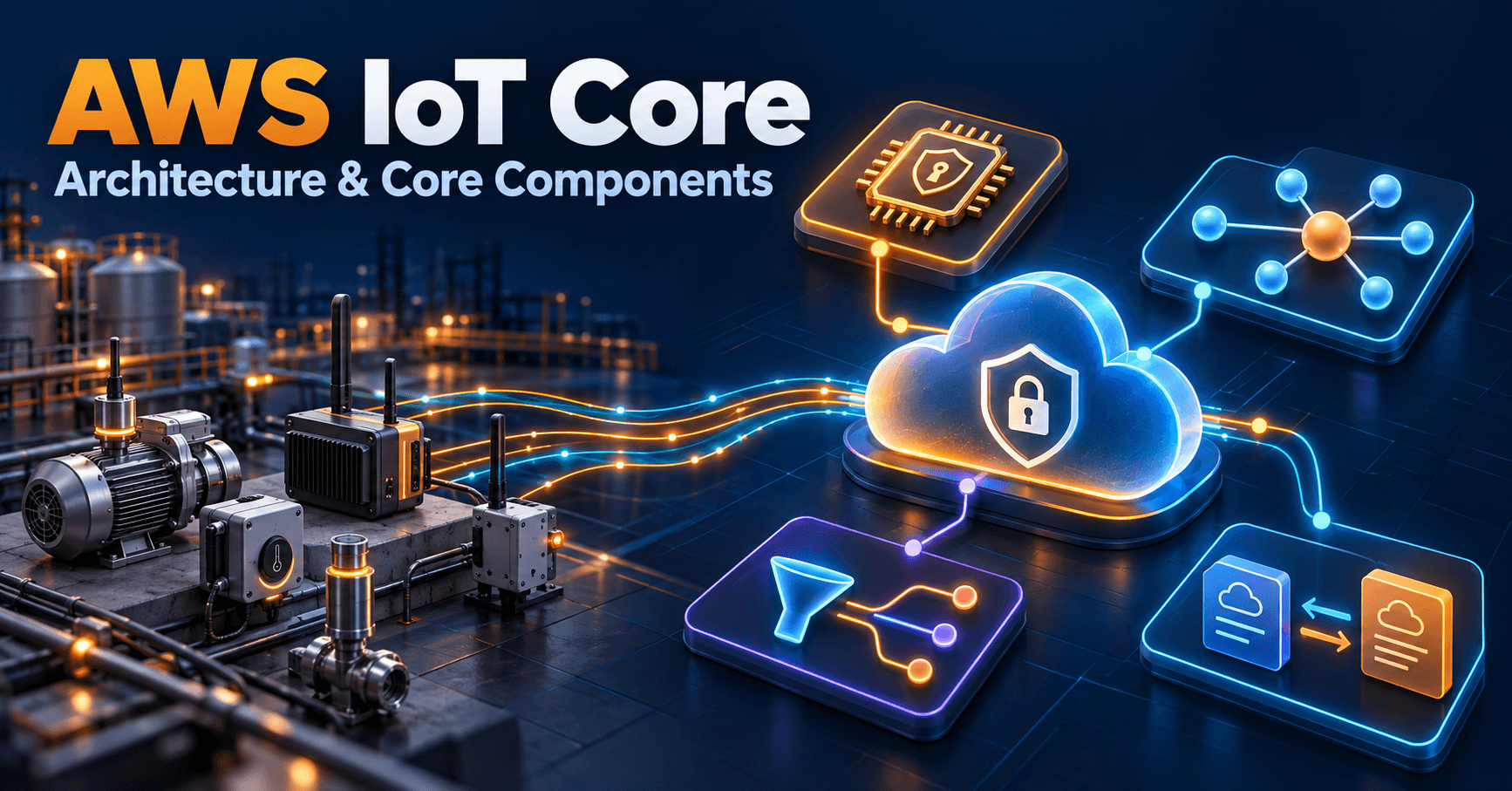
Four components do almost all the work: the MQTT message broker (device connectivity and pub/sub), the Rules Engine (routing and transforming inbound messages), Device Shadow (a persistent JSON document representing device state), and Fleet Provisioning (automated certificate and identity issuance at connect time). Each is independently useful, but production systems typically chain all four: a device provisions itself on first boot, connects over MQTT with the certificate it received, publishes telemetry that a rule routes to storage, and maintains a shadow so the cloud always has a last-known-good state even when the device is offline.
Message broker vs. rules engine vs. device shadow
It's easy to conflate these because they all touch the same MQTT topics, but they solve different problems. The broker is transport — it moves bytes between a device and a topic. The Rules Engine is a stream processor — it watches topics and executes SQL-like filters and actions on messages as they pass through, without the device knowing or caring. Device Shadow is a state store — it holds the last known desired and reported configuration for a device, persisted independently of whether the device is currently connected. A broker message is transient; a shadow document is durable until explicitly updated.
When to use AWS IoT Core vs. alternatives
AWS IoT Core makes sense when you need managed TLS-terminated MQTT at fleet scale (tens of thousands to millions of concurrent connections) without running your own broker cluster, and when you want tight IAM integration with the rest of an AWS data pipeline. If your fleet is a few dozen gateways pushing data to a single on-prem server, a self-hosted broker (Mosquitto, EMQX) is simpler and avoids per-message and per-connection billing. The decision also depends on your device tier — a constrained sensor node versus a gateway-class device have very different TLS and buffering capabilities, which affects whether they can even speak MQTT with mutual TLS directly or need a gateway to proxy on their behalf.
MQTT Broker: Device Communication Foundation
MQTT protocol basics and topic hierarchy
MQTT is a lightweight publish/subscribe protocol over TCP (typically port 8883 with TLS on AWS IoT Core). Topics are slash-delimited strings like factory/line1/sensor42/telemetry, with no central registration — any authorized client can publish or subscribe to any topic pattern, including wildcards (+ for a single level, # for multi-level, subscribe-only). A well-designed topic hierarchy encodes tenant, site, device type, and message type so that rules and IAM policies can filter by prefix instead of parsing payloads.
Pub/sub patterns for device-to-cloud and cloud-to-device messaging
This is the core distinction from a traditional message queue (SQS, RabbitMQ): MQTT brokers don't guarantee a single consumer per message. Any number of subscribers can receive a published message, and there's no built-in competing-consumers semantics or message visibility timeout. Device-to-cloud traffic typically publishes to dt/{thing}/telemetry; cloud-to-device commands publish to cmd/{thing}/request, which the device subscribes to at boot. Because AWS IoT Core itself isn't a durable queue, fan-out to actual queueing systems (SQS, Kinesis) happens via the Rules Engine, not the broker.
Quality of Service (QoS) levels and message persistence
AWS IoT Core supports QoS 0 and QoS 1 (QoS 2 is not supported). QoS 0 is fire-and-forget — no acknowledgment, lowest latency and bandwidth, acceptable for high-frequency telemetry where occasional loss doesn't matter (e.g., a vibration sensor sampling at 10 Hz). QoS 1 guarantees at-least-once delivery via PUBACK, at the cost of possible duplicates — appropriate for commands, firmware-update triggers, or billing-relevant events where loss is unacceptable but idempotent handling on the receiving end is feasible. There's no QoS 2 (exactly-once) tier, so if your application logic can't tolerate duplicates, you need idempotency keys in the payload regardless of QoS.
Connection management and certificate-based authentication
Every device connection is authenticated with mutual TLS: the device presents an X.509 certificate, and AWS IoT Core validates it against a registered CA or individually registered certificate, then evaluates an attached IAM-style policy to authorize specific topic actions. Clients should implement exponential backoff with jitter on reconnect, and must use unique MQTT client IDs — AWS IoT Core disconnects any existing session when a duplicate client ID connects, which is a common source of flapping connections in misconfigured fleets.
IoT Rules Engine: Data Processing and Routing
Rule syntax and condition-based message filtering
Rules use a SQL-like syntax evaluated against incoming message topics and JSON payloads:
SELECT temperature, humidity, timestamp() AS ts, topic(3) AS deviceId
FROM 'factory/+/sensor/telemetry'
WHERE temperature > 80
This selects fields, extracts a topic segment as a column, and filters to only messages exceeding a threshold — all before any Lambda or storage write happens, which keeps compute costs proportional to events that matter rather than raw message volume.
Built-in actions: DynamoDB, S3, Lambda, SNS, SQS routing
A single rule can fan out to multiple actions: write raw telemetry to DynamoDB for shadow-style lookups, archive the full payload to S3 for batch analytics, invoke a Lambda for business logic, and publish an SNS alert — all from one SELECT without the device publishing more than once. This is the mechanism that answers "what role does the Rules Engine play in the data pipeline": it's the fan-out and filtering layer that decouples device publishing patterns from however many downstream systems consume that data.
Transformation and enrichment of MQTT payloads
Payloads can be reshaped inline using SQL functions — renaming fields, converting units, concatenating strings, or calling aws_lambda() as an inline enrichment function that looks up reference data (e.g., mapping a device ID to a customer account) before the message proceeds to its final action. For enrichment too complex for SQL expressions, route to Lambda first and have the Lambda republish a normalized message to a second topic that downstream rules consume.
Error handling and dead-letter queues
Every rule should have an error action configured — typically an SQS queue or CloudWatch Logs — because a rule with no error action silently drops failed actions (e.g., a Lambda throttling error or a DynamoDB write exceeding a thousand-character primary key). Treat the error action as a dead-letter queue: alert on its depth, and replay from it after fixing the downstream fault.
Device Shadow: State Management and Offline Sync
Desired vs. reported state model
A shadow document has two primary sections: desired (what the cloud wants the device to be) and reported (what the device last confirmed). The cloud updates desired (e.g., {"desired":{"fanSpeed":3}}) regardless of whether the device is online; the device, upon reconnecting, receives a delta between desired and reported, applies it, and publishes a reported update to close the loop.
Shadow metadata and versioning
Each shadow has a version number that increments on every update and a metadata block with per-field timestamps. Clients should use version as an optimistic-concurrency check — reject or retry updates if the version in a request doesn't match the current document, to avoid clobbering concurrent writes from another client or rule.
Keeping devices in sync during connectivity loss
This is the direct answer to "when should I use Device Shadow vs. direct MQTT messages": use MQTT for time-sensitive telemetry and commands that are worthless if delayed, and use Shadow for configuration state that must eventually converge even if the device is offline for hours. A direct MQTT command published while a device is disconnected is simply lost; a shadow update persists and is delivered as a delta the moment the device reconnects and subscribes to $aws/things/{name}/shadow/update/delta.
Shadow REST API and MQTT topics
Shadows are accessible both via MQTT reserved topics ($aws/things/{name}/shadow/update, /get, /delete and their /accepted//rejected responses) and via an HTTPS REST API, which matters for backend services or dashboards that want to read/write shadow state without maintaining an MQTT connection.
Fleet Provisioning: Zero-Touch Onboarding at Scale
Just-in-Time Registration (JITR) workflow
JITR lets a device connect with a certificate signed by a CA you've registered with AWS IoT Core but never individually uploaded. On first connection, a Lambda triggered by the registration event activates the certificate and attaches a policy — useful when certificates are burned into devices during manufacturing, before any AWS-side registration exists.
Provisioning templates and claim certificates
Fleet Provisioning (the newer, more common approach) ships every device with a shared, narrowly-scoped claim certificate that can only call the provisioning API. On first boot, the device uses the claim cert to request a unique certificate and thing registration via a provisioning template — a JSON document defining what IAM policy, thing type, and attributes to assign. This is the mechanism behind zero-touch onboarding: no human touches the device or a provisioning portal; the template logic entirely determines identity assignment based on parameters the device supplies (serial number, MAC address) at request time.
Automated certificate and policy generation
The provisioning template can invoke a Lambda for pre-provisioning hooks — validating a serial number against a manufacturing database before approving a certificate, rejecting counterfeit or duplicate units. This closes the loop between physical manufacturing records and cloud identity.
Integration with manufacturing and deployment pipelines
In practice, claim certificates are injected during PCB flashing or a secure-element provisioning step on the line, and the manufacturing execution system logs which claim cert and serial number went into which unit — so that if a batch of claim certs is compromised, you can trace and revoke exactly the affected units rather than the whole fleet.
Security and Certificate Management
Mutual TLS (mTLS) authentication requirements
Every device-to-broker connection requires mTLS: no username/password or API-key fallback exists for device connections (IAM-authenticated WebSocket connections are the exception, used mainly by backend services, not field devices). Devices need accurate wall-clock time to validate certificate expiry and chain validity, which is a real constraint for devices without RTC backup power after a long storage period.
Certificate lifecycle and rotation strategies
Plan certificate rotation before deployment, not after an expiry incident. AWS IoT Core supports certificate rotation by issuing a new certificate to an already-provisioned thing, activating it, and deactivating the old one — devices should implement logic to accept a rotation command via a shadow or dedicated topic and restart their TLS session with the new credential rather than requiring a factory reset.
IAM policies and least-privilege access
Each certificate's IoT policy should scope iot:Publish/iot:Subscribe to the specific topic patterns that thing needs, typically parameterized with ${iot:Connection.Thing.ThingName} so one policy template applies to the whole fleet without granting cross-device topic access — a device compromised at the edge shouldn't be able to publish to another device's command topic.
Secure provisioning flows for constrained devices
For devices too constrained to generate their own key pairs on-device (a real concern covered in IoT connectivity trade-offs around power and cost), key generation may need to happen in a secure element or HSM during manufacturing rather than at first boot, with Fleet Provisioning only handling certificate issuance against a pre-existing key.
Practical Implementation Patterns
Device SDK selection and connection setup
AWS provides SDKs (C, Python, Java, JavaScript, embedded C for microcontrollers) built on top of MQTT libraries with built-in TLS handling, backoff, and shadow helper methods. For MCU-class devices, the embedded C SDK is designed for constrained RAM/flash budgets; for gateway-class Linux devices, the Python or Java SDK is usually simpler to integrate with existing application code.
Handling network interruptions and reconnection logic
Use MQTT's persistent session (cleanSession=false equivalent) so queued QoS 1 messages and subscriptions survive short disconnects, and implement exponential backoff with a jitter window (e.g., 1–30 s) to avoid thundering-herd reconnect storms after a regional network outage affecting thousands of devices simultaneously.
Monitoring and troubleshooting with CloudWatch
Enable AWS IoT Core logging to CloudWatch Logs at least at the ERROR level in production (WARN or DEBUG during rollout) — it captures connection failures, rule execution errors, and authorization rejections with the exact policy or rule name responsible, which is far faster to debug than inferring failures from missing data downstream.
Cost optimization for high-volume deployments
Billing is driven by connection minutes, messages, and rules-triggered actions, so the biggest cost levers are: reducing publish frequency where QoS 0 telemetry can be batched client-side into fewer, larger messages, filtering aggressively in rule WHERE clauses so Lambda invocations only fire on meaningful events, and using shadow updates sparingly since each update itself consumes a message. Revisit these costs any time fleet size grows past a pilot — the pricing model that looked negligible at sensors, connectivity, cloud, and analytics scale of a few hundred units can shift meaningfully at six-figure device counts.
Learning
Sign in to track your progress.
Evidence
Public projects engineers linked to AWS IoT Core: MQTT Broker, Rules, Shadow, Fleet Provisioning.
No engineer has linked a project to this topic yet. Built something that proves it? Add the project and tag it with iot-connectivity-aws-iot-core-mqtt-broker-rules-shadow-fleet-provis — it then shows here and on your public profile.