
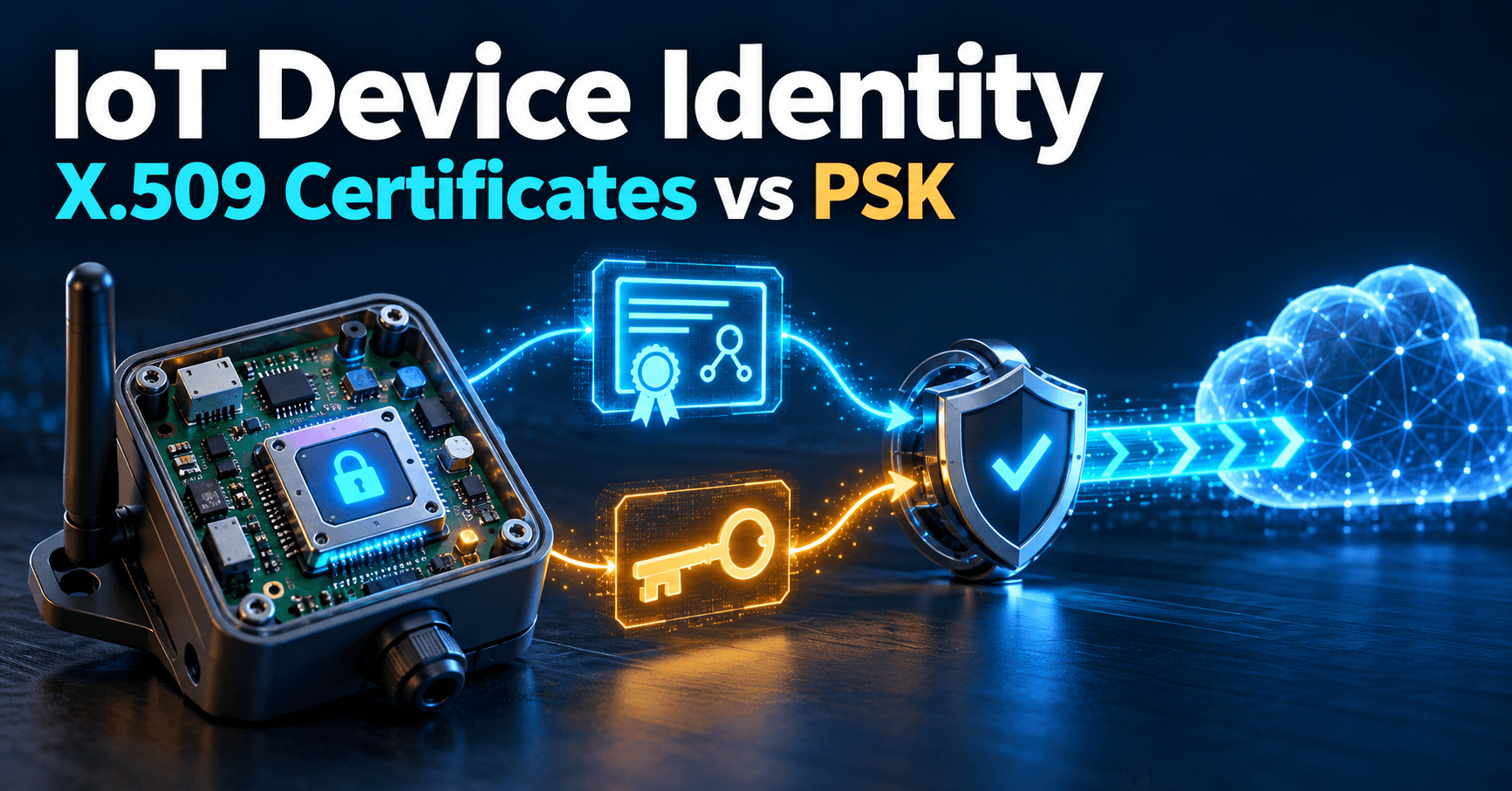
Device Identity: X.509 Certificate, Pre-Shared Key (PSK)
Compare X.509 certificates and pre-shared keys for IoT device authentication, with guidance on memory, power, and lifecycle trade-offs.
Contents & prerequisites
Why Device Identity Matters in IoT
Every message an IoT device sends carries an implicit claim: "I am who I say I am." Without a mechanism to verify that claim, a cloud platform or gateway has no way to distinguish a legitimate temperature sensor from a spoofed endpoint replaying stale telemetry or injecting false commands. Device identity is the credential — cryptographic, not just a serial number — that backs up that claim.
Authentication as a foundational security layer
Authentication sits underneath encryption and authorization in the security stack. You can encrypt a channel with a perfectly strong cipher and still be talking to an attacker if you never verified who holds the other end of the connection. In IoT this matters more than in traditional IT because devices are frequently deployed unattended, in physically accessible locations, for years at a stretch. The identity mechanism chosen at design time — X.509 certificate or pre-shared key — determines how that device proves itself for its entire operational life.
Identity verification in untrusted networks
Unlike servers in a data center, IoT devices routinely communicate over public cellular links, unlicensed radio, or third-party Wi-Fi. The network itself must be treated as hostile. Mutual authentication — the server proving itself to the device and vice versa — closes the door on man-in-the-middle attacks and rogue gateway impersonation. This requirement looks different depending on where in the stack you sit; if you're still orienting to where authentication fits relative to radios and application logic, it's worth reviewing the IoT architecture layers of perception, network, and application before deciding which identity scheme to apply at which hop.
Compliance and regulatory requirements
Regulations such as the EU Cyber Resilience Act, UK PSTI, and sector-specific standards like IEC 62443 for industrial control systems increasingly mandate unique per-device credentials and a documented revocation path. "Shared factory default password" or a single global PSK baked into every unit no longer clears an audit. Whichever identity mechanism you choose, you need an answer to "how do you revoke one compromised device without touching the rest of the fleet" — a question that shapes the rest of this article.
X.509 Certificate-Based Identity
Certificate structure and components
An X.509 certificate binds a public key to a subject identity (device serial number, manufacturing batch, or fleet ID) and is signed by a Certificate Authority (CA). The structure — version, serial number, issuer, validity period, subject, public key, extensions, and signature — is standardized in RFC 5280. For embedded use, the certificate chain usually has three tiers: a root CA (offline, rarely touched), an intermediate CA (used for day-to-day signing), and the leaf (device) certificate. Devices typically need to store their own leaf certificate, their private key, and the intermediate/root chain needed to validate the peer.
Public Key Infrastructure (PKI) deployment
PKI requires standing infrastructure: a CA (self-operated or via a managed service like AWS IoT Core's Just-in-Time Registration, Azure IoT Hub DPS, or a dedicated PKI vendor), a registration authority to validate enrollment requests, and a distribution mechanism to get signed certificates onto devices during manufacturing or first boot. This is nontrivial operational overhead but it decouples trust from any single shared secret — compromising one device's key does not expose any other device.
Certificate lifecycle: issuance, renewal, revocation
Certificates expire by design — typically 1 to 5 years for leaf certificates in IoT deployments, shorter for high-assurance environments. Renewal before expiry requires the device to generate (or reuse) a key pair, submit a certificate signing request, and receive a new certificate — all while the old one is still valid, to avoid a hard outage. Revocation is handled via Certificate Revocation Lists (CRL) or OCSP, both of which assume the device or verifying party has network access to check revocation status, which is not a given for intermittently connected sensors.
Hardware vs. software certificate storage
The private key associated with a certificate is the actual secret worth protecting; the certificate itself is public by design. Storing the private key in a secure element, TPM, or MCU-integrated secure enclave means the key never leaves protected silicon — operations like signing happen inside the chip. Software-only storage (encrypted flash, OTP memory) is cheaper but vulnerable to extraction via JTAG/SWD access or fault injection if the device lacks tamper resistance.
Asymmetric cryptography overhead on constrained devices
ECDSA with a P-256 curve, the common choice for constrained X.509 deployments, still costs tens of milliseconds for a signature or verification operation on a sub-100 MHz Cortex-M0/M3 class MCU without hardware crypto acceleration, and the TLS handshake pulls in several KB of certificate chain data over the wire. For a device that wakes once an hour to report a reading and sleeps the rest of the time, that handshake cost dominates total energy per session. This is precisely the tension described in the constrained devices RFC 7228 class 0, 1, 2 definitions: a Class 1 device (~10 KB RAM, ~100 KB flash) can technically run a TLS 1.2 stack with ECC, but the energy and latency budget may not tolerate it for every wake cycle.
Pre-Shared Key (PSK) Authentication
Symmetric key provisioning and management
A PSK is a shared secret, typically 128 or 256 bits, installed on both the device and the server (or a key distribution service) ahead of time. There's no CA, no chain validation, no certificate parsing — just a key lookup by identity hint and a symmetric handshake (TLS-PSK, RFC 4279/4785, or DTLS-PSK for CoAP/UDP transports).
Reduced computational burden on edge devices
Symmetric operations — AES, HMAC — run orders of magnitude faster than ECC point multiplication and need no large key-pair generation step. A PSK-based DTLS handshake can complete in a fraction of the CPU cycles and RAM footprint of a full X.509 handshake, which matters directly for battery life: fewer active CPU cycles per connection, shorter radio-on time, lower average current draw across the device's duty cycle.
Key derivation and session establishment
PSK-based TLS/DTLS still derives unique session keys per connection via a key derivation function seeded by the PSK and handshake nonces, so a captured session doesn't trivially reveal the long-term secret, and forward secrecy can be added with PSK-ECDHE cipher suites at a modest computational premium over pure PSK, still well below the cost of full certificate-based key exchange.
Scaling challenges with PSK distribution
The weakness is operational, not cryptographic: every device needs a provisioned key, and if you use one shared key per product line rather than per device, a single extraction event (one compromised unit reverse-engineered) compromises the entire fleet. Per-device unique PSKs avoid that but push the same provisioning-database and secure-injection burden onto manufacturing that PKI pushes onto a CA — except without a built-in revocation or chain-of-trust mechanism, so a compromised key typically has to be manually pulled from the server-side key store.
X.509 vs. PSK: Trade-Offs and Selection Criteria
Security posture and attack surface comparison
X.509 isolates compromise to a single device and supports standardized revocation; PSK, especially shared PSKs, risks fleet-wide compromise from one extracted key but reduces the attack surface tied to certificate parsing bugs and CA trust chain errors — a real source of TLS vulnerabilities historically.
Processing power, memory, and power consumption
As a rule of thumb for design planning (confirm exact figures against your MCU's datasheet and crypto library benchmarks): ECC operations cost roughly 10-50x the CPU cycles of equivalent AES/HMAC operations on a comparable constrained core, and certificate chains add several KB to flash and to each handshake's wire payload. For a coin-cell device transmitting once per hour, that difference can determine whether the battery lasts one year or five.
Key management complexity and operational overhead
PSK pushes complexity into secure provisioning and key-store operations; X.509 pushes it into CA infrastructure, certificate lifecycle automation, and revocation distribution. Neither is "simpler" in absolute terms — the complexity moves rather than disappears.
Use case mapping: industrial vs. consumer IoT
A factory floor with thousands of sensors behind a hardened gateway, long device lifetimes, and dedicated OT security staff can absorb PKI overhead and benefits from its auditability. A disposable consumer sensor with a two-year lifespan and cost-sensitive BOM may be better served by per-device PSKs provisioned at manufacturing time. The split described in Industrial IoT vs. Consumer IoT differences — differing lifespans, failure tolerance, and security staffing — maps directly onto this identity-scheme decision.
Implementation Considerations for Constrained Devices
Credential storage on flash and secure enclaves
Whichever scheme you choose, the credential — private key or PSK — should not sit in plaintext in general-purpose flash readable via a debug port left enabled in production. Secure elements (e.g., ATECC-class parts), MCU-integrated secure enclaves, or at minimum flash readout protection fuses are the baseline. PSKs are smaller and simpler to wrap with an on-chip key-encryption-key than a full certificate chain, which can be an argument in favor of PSK on the smallest devices.
Protocol integration: TLS, DTLS, CoAP
TLS 1.2/1.3 over TCP supports both X.509 and PSK cipher suites natively. For constrained radios running CoAP over UDP, DTLS 1.2 with PSK cipher suites is the common lightweight path; DTLS with ECC certificates is supported but noticeably heavier on RAM for the handshake state machine. Check your TLS library (mbedTLS, wolfSSL) build flags — many let you compile out the X.509 parser entirely if you commit to PSK-only, reclaiming tens of KB of flash.
Firmware update and certificate rotation workflows
Certificate rotation should be tied to your OTA update mechanism — a device that successfully reports its certificate expiry window should be able to pull a renewed cert via the same channel it gets firmware, ideally a few weeks ahead of expiry with retry logic for devices that miss the window due to connectivity gaps. PSK rotation needs an equivalent out-of-band path, since there's no PKI machinery to automate it; many deployments rotate PSKs rarely, if ever, which is itself a risk to document and accept consciously rather than by default.
Supply chain provisioning strategies
Both schemes require injecting a secret during manufacturing or first-boot provisioning. X.509 provisioning typically happens via a hardware security module (HSM) in the factory signing a CSR generated on-device; PSK provisioning typically means a programming station flashing a unique key per unit from a secured database. Either way, the manufacturing test fixture becomes a high-value attack target and should be access-controlled and audited accordingly.
Real-World Deployment Patterns
Hybrid approaches: PSK for bootstrap, X.509 for long-term
A common pattern: a device ships with a factory-installed PSK used only for the initial secure connection to a provisioning service, which then issues a per-device X.509 certificate over that already-authenticated channel. This gets the low-cost, low-compute bootstrap benefit of PSK while landing on the stronger long-term isolation of per-device certificates — answering directly whether the two schemes can coexist: yes, and this is the most common way they do.
Gateway and constrained device role differentiation
In many topologies the most constrained leaf devices use PSK to talk to a local gateway, while the gateway itself — which has more CPU, power, and often mains power — maintains an X.509 identity for its connection to the cloud. This mirrors the tiered trust model described in IoT device classification: constrained, gateway, cloud, where authentication rigor scales with the compute budget available at each tier.
Cloud onboarding and identity federation
Cloud IoT platforms generally expect X.509 at the point of federation — AWS IoT Core, Azure IoT Hub, and Google Cloud IoT all build their device registries around certificate-based identity, with PSK support more limited or requiring a custom authorizer. If your constrained devices use PSK locally, the gateway is usually the component that re-authenticates to the cloud using certificates, translating identity across the trust boundary.
Revocation and compromise response
Plan the incident response before you need it: for X.509, know which CRL/OCSP endpoint your fleet checks and how fast a revocation propagates; for PSK, know which server-side table entry to disable and whether that requires a device-side key rotation to fully recover, since simply blocking the key server-side doesn't stop a cloned device from working on isolated local networks. Document this response path as part of the same lifecycle plan that covers routine renewal — an identity scheme without a tested revocation drill is incomplete regardless of which cryptography underlies it.
Learning
Sign in to track your progress.
Evidence
Public projects engineers linked to Device Identity: X.509 Certificate, Pre-Shared Key (PSK).
No engineer has linked a project to this topic yet. Built something that proves it? Add the project and tag it with iot-connectivity-device-identity-x509-certificate-pre-shared-key-ps — it then shows here and on your public profile.