
Galvanic Skin Response (GSR): Sympathetic Nervous Indicator
Galvanic skin response (GSR) measurement for embedded engineers: electrode choice, excitation methods, noise sources, and firmware signal processing.
Contents & prerequisites
What Is Galvanic Skin Response?
Definition and physical basis
Galvanic Skin Response (GSR), also called electrodermal activity (EDA), is the change in the electrical conductance of skin that accompanies sweat gland activity. The "galvanic" in the name is a historical artifact — early investigators believed they were observing a self-generated electrical potential analogous to galvanic cells. In fact, the dominant effect in modern GSR instrumentation is a change in conductivity driven by an externally applied excitation, not an endogenous voltage, though a smaller endogenous skin potential does exist and is measured separately in some research setups.
Skin conductivity vs. skin resistance
Skin resistance typically ranges from roughly 50 kΩ to well over 1 MΩ across two electrodes placed a few centimeters apart on the palm or fingers, depending on hydration, electrode size, and sweat gland density. Most modern systems report conductance (siemens, typically expressed in microsiemens, µS) rather than resistance, because sweat gland recruitment increases conductance in a roughly linear, additive fashion — multiple parallel sweat ducts act as parallel conductive paths, and parallel conductances add directly, whereas the corresponding resistances combine reciprocally. This makes conductance the physiologically and mathematically more natural unit for GSR signal processing.
Why GSR reflects sympathetic state
Sweat glands relevant to GSR are innervated exclusively by the sympathetic branch of the autonomic nervous system, with no parasympathetic antagonism. This is unusual — most sympathetically-driven organs have a parasympathetic counterpart that can mask or complicate the signal. Because GSR has a single-branch innervation, it is one of the cleanest available peripheral windows into sympathetic arousal, uncontaminated by vagal tone in the way that heart rate variability often is.
Physiological Mechanism: Sweat Glands and Conductivity
Role of eccrine sweat glands in GSR
GSR arises almost entirely from eccrine sweat glands, which are distinct from apocrine glands and are densely concentrated on the palms and soles (up to 400–600 glands/cm² in some regions). These glands exist primarily for thermoregulation but are also recruited during emotional and cognitive arousal independent of temperature, which is what makes them useful as an arousal sensor.
Ionic composition and electrical conductivity
Eccrine sweat is a dilute electrolyte solution, mainly sodium and chloride ions, with conductivity on the order of a few mS/cm when fully secreted. As sweat fills the duct and reaches the skin surface, it forms a low-impedance parallel path across the stratum corneum, which is otherwise a relatively poor conductor. The net conductance measured at the skin surface is a function of how many ducts are actively filled and how close that sweat is to the surface — not solely of total secretion volume.
Sympathetic neural control pathway
The signal pathway runs from the hypothalamus and limbic structures, through sympathetic cholinergic fibers (an exception to the usual adrenergic sympathetic pattern), to acetylcholine release at the sweat gland. This is a key firmware-relevant fact: because the neurotransmitter is acetylcholine rather than norepinephrine, GSR dynamics do not track catecholamine-driven cardiovascular measures, such as those used in Pulse Wave Velocity (PWV) and Arterial Stiffness assessment, on a 1:1 basis. The two signals are correlated during arousal but diverge in latency and recovery shape.
Time constants and response dynamics
A phasic GSR event following a discrete stimulus typically shows a latency of 1–3 seconds, a rise time to peak of 1–3 seconds, and a half-recovery time of 2–10 seconds, depending on the subject and electrode site. These numbers matter directly for sample rate and filter design, covered below.
Measurement Principles and Signal Characteristics
Exosomatic and endosomatic configurations
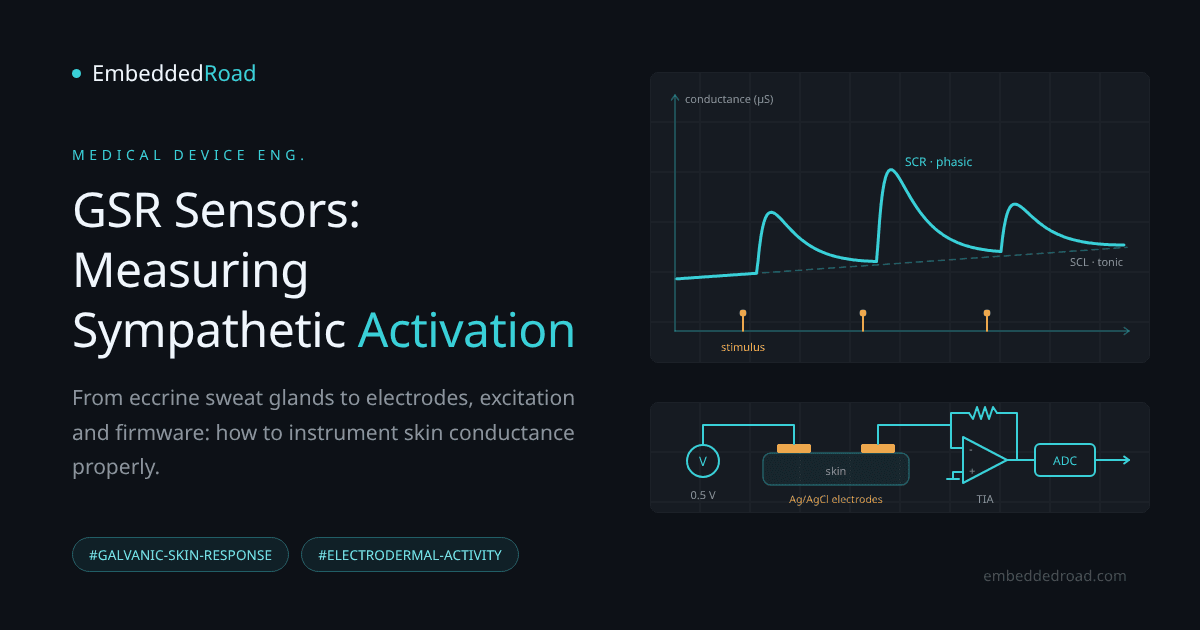
The classic configuration is two Ag/AgCl electrodes placed on adjacent fingers or the palm, with a small constant voltage or constant current applied across them (exosomatic measurement). A less common endosomatic method measures the skin's own bioelectric potential with no excitation applied, but it is noisier and rarely used outside specialized labs. For wearable integration, two-electrode exosomatic measurement dominates because it needs only two contact points and a simple analog front end.
Tonic vs. phasic GSR components
The signal decomposes into two components that must be treated separately in firmware:
- Tonic (Skin Conductance Level, SCL): the slow-moving baseline, drifting over tens of seconds to minutes, reflecting overall arousal state, hydration, and ambient temperature.
- Phasic (Skin Conductance Responses, SCRs): fast, transient deflections of roughly 0.01–several µS superimposed on the tonic level, triggered by discrete stimuli or spontaneous sympathetic bursts.
Conflating the two is the single most common interpretation error: a rising tonic baseline from heat or motion can be mistaken for sustained arousal, while genuine stimulus-locked SCRs can be lost in tonic drift if the high-pass corner is set incorrectly.
Typical amplitude ranges and frequency content
Tonic SCL typically ranges 2–20 µS; phasic SCRs are smaller, 0.01–3 µS, riding on top. Useful signal content lives below roughly 1–2 Hz; most SCR energy is under 0.5 Hz. This is a low-bandwidth signal by embedded standards, which is good news for power budgets but means aliasing and 1/f noise must be handled deliberately rather than brute-forced with high sample rates.
Contact impedance and electrode polarization effects
Electrode-skin contact impedance introduces a resistive and capacitive element in series with the tissue, which can be modeled with the same two-port formalism used in Two-Port Network Parameters: Z, Y, H, ABCD, treating the electrode interface and tissue as cascaded two-port blocks. Polarizable electrodes (plain metal) build up a DC offset under constant current excitation; non-polarizable Ag/AgCl electrodes minimize this but still require stable, low-pressure contact to avoid motion-induced impedance transients.
Hardware Design: Signal Acquisition and Conditioning
Excitation voltage and current source selection
Safety and signal integrity both bound the excitation choice. Applied voltage is conventionally kept at or below 0.5 V to avoid electrolytic or iontophoretic effects on the skin and to stay within surface limits used in electrodermal research protocols. Constant-voltage excitation with a current-to-voltage (transimpedance) stage is the common choice because the output then maps linearly to conductance without a division step in firmware. Constant-current excitation, kept to a few microamps (at or below about 10 µA/cm² of electrode area), produces a voltage proportional to resistance, which firmware must invert to report conductance.
AC vs. DC measurement approaches
DC excitation is simpler but is more susceptible to electrode polarization and DC offset drift. AC excitation, typically a low-frequency sine or square wave in the range of tens of Hz to a few hundred Hz, avoids net polarization and allows synchronous demodulation, giving better rejection of DC drift and 50/60 Hz mains interference when the excitation frequency is chosen away from mains harmonics. The trade-off is added circuit complexity: a signal generator, a synchronous demodulator or lock-in stage, and tighter phase-noise control.
Noise sources and filtering strategies
Primary noise sources are motion artifact (mechanical disturbance of electrode contact), mains interference, thermal drift in the excitation source, and sweat gland response to incidental thermal or respiratory changes that are not sympathetically meaningful. A practical filter chain:
Electrode -> I-V transimpedance stage -> anti-alias LPF (~5 Hz corner)
   -> ADC (sample rate 16-32 Hz is typically sufficient)
   -> digital split:
        tonic  = low-pass (<0.05 Hz) running baseline
        phasic = bandpass (0.05-1 Hz) for SCR detection
Oversampling well above the ~1 Hz signal content and decimating in firmware is cheap given the low bandwidth, and it relaxes the analog anti-alias filter requirements considerably.
Amplification and analog-to-digital conversion
Given microsiemens-level signals and sub-volt excitation, the transimpedance/instrumentation amplifier stage needs low input bias current and low 1/f noise; a CMOS-input or chopper-stabilized op-amp is the usual choice. Internally, most such parts use the classic architecture covered in Two-Stage Op-Amp: Differential Input + Common-Source Output; at board level, what matters is that the part's input bias current and low-frequency (0.1–10 Hz) noise are negligible next to the signal current. A 16-bit ADC is generally more than adequate given the signal's limited dynamic range and bandwidth; the bottleneck is almost always analog front-end noise and contact quality, not quantization.
Electrode materials and skin contact considerations
Ag/AgCl with conductive gel remains the reference standard for research-grade accuracy; dry stainless steel or conductive rubber electrodes are common in consumer wearables for comfort and reusability but introduce higher and more variable contact impedance. Electrode site matters: palmar and plantar sites have far higher eccrine density than wrist or forearm sites commonly used in wristband wearables, and wrist-based GSR typically shows attenuated amplitude and slower apparent dynamics compared to finger measurements.
Clinical and Research Applications
Stress and emotional state detection
Phasic SCR frequency and amplitude correlate with acute stress and emotional arousal and are widely used in psychophysiology research as a proxy for sympathetic activation when direct sympathetic recording, such as microneurography of muscle sympathetic nerve activity, is neither necessary nor practical for a general arousal estimate.
Lie detection and deception analysis
GSR is one channel in traditional polygraphy, under the assumption that deception increases sympathetic arousal. This application is scientifically contested: GSR indexes arousal in general, not deception specifically, and confounds from anxiety, novelty, or cognitive load are well documented in the forensic psychophysiology literature.
Mental workload assessment
Tonic SCL tends to track sustained cognitive load during demanding tasks, making it a candidate channel in human-factors and cognitive-load monitoring systems, usually combined with other channels such as pupillometry or heart rate variability.
Sleep and circadian monitoring
Spontaneous SCR rate varies across sleep stages and circadian phase, with bursts of SCRs (so-called EDA storms) most frequent in slow-wave (deep) sleep and least frequent in REM sleep, making GSR a secondary channel in some ambulatory sleep-staging devices, though it is not sufficient alone for stage classification.
Limitations and confounding factors
GSR cannot distinguish arousal valence (fear vs. excitement look similar), is confounded by ambient temperature and humidity, varies with hydration and skin thickness, and has substantial inter-subject and even site-to-site variability on the same subject.
System Integration in Wearable and Portable Devices
Form factor constraints and sensor placement
Finger and palm sites give the strongest signal but are impractical for continuous wear; wrist and foot sites are more wearable-friendly but yield weaker, slower signals. The site choice should be made explicit in product requirements, since it changes expected amplitude and bandwidth, not just comfort.
Power consumption and battery considerations
Because useful GSR bandwidth is under a few Hz, duty-cycled excitation and ADC sampling (e.g., waking the analog front end for a short window every 100–500 ms) can cut power substantially compared to continuous excitation, at the cost of added firmware complexity for reconstructing phasic onset timing.
Real-time data processing and feature extraction
On-device feature extraction — SCR count, amplitude, rise time, tonic slope — reduces the data volume needing transmission and allows real-time alerting without streaming raw waveform data continuously, which matters for both power and privacy.
Wireless transmission and data privacy
GSR, like many physiological signals, is sensitive personal health data; feature-level transmission rather than raw waveform streaming reduces both bandwidth and the attack surface for re-identification or inference of emotional state, which is a nontrivial privacy consideration in consumer wearables.
Data Interpretation and Clinical Validity
Baseline and individual variability
Absolute SCL varies widely between individuals due to skin thickness, gland density, and baseline hydration; cross-subject comparisons require normalization (e.g., range correction or z-scoring against a subject-specific baseline period) rather than use of raw conductance values.
Artifact rejection and signal quality assessment
Rapid step changes inconsistent with the expected 1–3 second SCR rise time, and conductance discontinuities coincident with accelerometer-detected motion, are standard markers for artifact rejection in firmware or post-processing pipelines.
Correlation with autonomic markers
GSR correlates with but is not interchangeable with other autonomic markers such as heart rate variability or pupil dilation; multimodal fusion is standard practice in research-grade systems that need a robust arousal estimate rather than a single noisy channel.
Standardization and reproducibility challenges
Unlike more mature vital-sign measurements, GSR acquisition lacks a single universally adopted standard for electrode placement, excitation parameters, and normalization, which complicates cross-study and cross-device comparison and is an active area of standardization effort in psychophysiology and wearable-health research bodies.
Learning
Sign in to track your progress.
Evidence
Public projects engineers linked to Galvanic Skin Response (GSR): Sympathetic Nervous Indicator.
No engineer has linked a project to this topic yet. Built something that proves it? Add the project and tag it with medical-devices-galvanic-skin-response-gsr-sympathetic-nervous-ind — it then shows here and on your public profile.