
Animal Welfare and Precision Livestock Farming
Learn how embedded sensors, signal conditioning, and wireless links turn livestock biometrics into real-time animal welfare alerts.
Contents & prerequisites
Prerequisites
Why Animal Welfare Matters in Modern Farming
Precision livestock farming (PLF) exists at the intersection of animal science and embedded systems engineering. For an engineer, "animal welfare" is not an abstract ethical category — it is a set of measurable physiological and behavioral signals that must be acquired, conditioned, transmitted, and interpreted reliably in a hostile electrical and mechanical environment. The business case for doing this well is concrete, and it shapes every design decision downstream.
Regulatory and market drivers for welfare standards
Retailers and export markets increasingly require documented welfare compliance (e.g., EU welfare directives and retailer audit schemes, USDA Organic animal-care rules). Audits are shifting from subjective visual inspection to data logs — time-stamped temperature, activity, and health-event records pulled from embedded devices. This means your sensor firmware's data integrity and timestamp accuracy are now compliance artifacts, not just engineering nice-to-haves.
Economic impact of stress-related production loss
Heat stress alone can reduce dairy milk yield by 10-25% during sustained thermal events, and subclinical illness in swine or poultry often causes feed-conversion losses before any visible symptom appears. The economic argument for embedded monitoring is simple: a sensor system that shaves 24-48 hours off detection time for a treatable condition pays for itself over a single herd cycle.
Embedded systems as enablers, not replacements, for observation
Sensors do not replace stockpersons; they extend observational bandwidth. A herd manager cannot palpate 500 cows twice a day, but a tag-based system can continuously sample all 500 and flag the 3 that need attention. The design goal is to reduce false negatives (missed sick animals) without flooding the farm manager with false positives that erode trust in the system.
Core Biometric Parameters for Livestock Monitoring
Body temperature and heat stress detection
Core body temperature is the earliest and most direct heat-stress indicator, typically measured via reticulorumen boluses, rectal thermistors, or infrared skin-surface proxies on ear tags. A rise of 0.5-1.0°C above an animal's rolling baseline, sustained for more than 2 hours, is a common clinical threshold worth encoding as a configurable parameter rather than a hard-coded constant — breed and species baselines vary (see breed-specific veterinary reference tables, not reproduced here).
Respiratory rate and illness indicators
Respiratory rate, derived from flank-strap strain gauges, accelerometer-detected chest wall motion, or acoustic sensors, is a leading indicator of both heat stress and respiratory disease. A healthy resting rate for cattle is roughly 20-40 breaths/min; panting above 80 breaths/min signals acute heat stress requiring intervention within hours, not days.
Behavioral metrics: movement, posture, feeding patterns
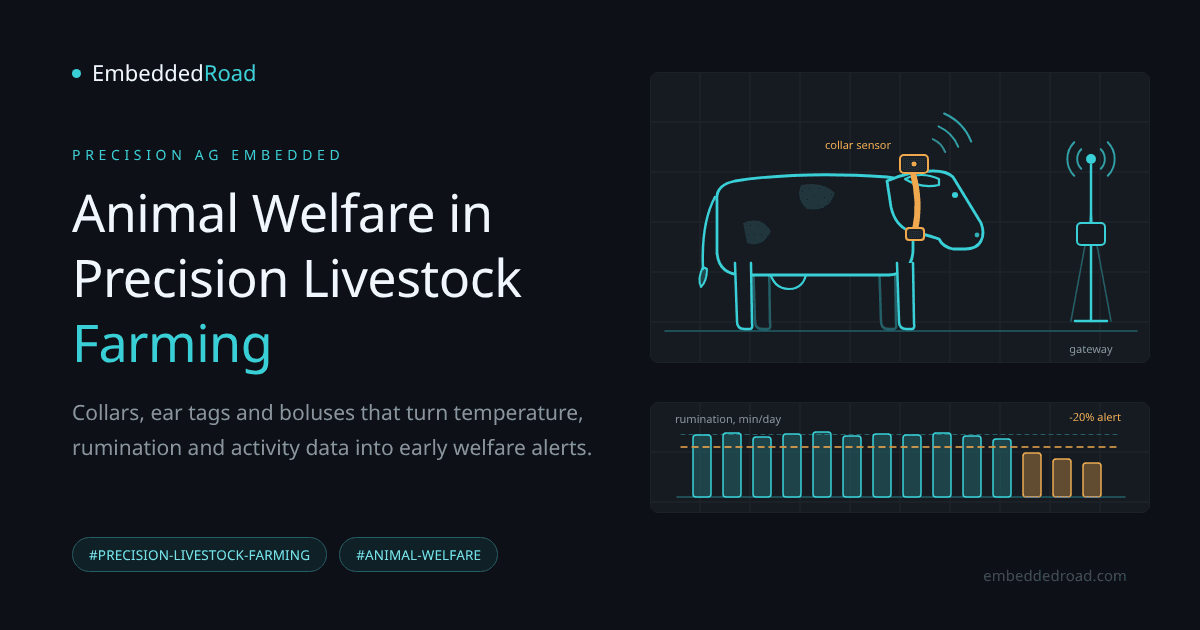
Accelerometer- and gyroscope-derived metrics — standing time, lying bouts, rumination chews/minute, feeding visits — correlate strongly with subclinical disease and lameness before temperature changes are detectable. A drop in rumination time of more than 20% from a 7-day rolling average is a widely used clinical alert threshold in dairy management software.
Why continuous measurement beats periodic checks
Periodic manual checks (once or twice daily) sample a slow-moving average and miss transient events — a 3-hour heat spike during midday can trigger irreversible metabolic stress yet be invisible at a 6 a.m. and 6 p.m. check. Continuous sampling at 1 Hz to 0.1 Hz, with onboard trend detection, captures the derivative, not just the value — critical because rate-of-change often precedes absolute-threshold breach.
Sensor Placement and Data Acquisition in Farm Environments
Wearable collar and ear-tag form factors
Collars carry larger batteries and antennas but add weight and risk of entanglement; ear tags are lighter and less invasive but constrain battery volume to a few hundred mAh and antenna efficiency due to near-body RF loading. Rumen boluses give the best core-temperature accuracy but require specialized insertion and cannot be retrieved without slaughter — a one-way deployment decision.
Harsh-environment sensor durability requirements
Enclosures need IP67-or-better ingress protection and must survive repeated impact against fencing and feed bunks, UV exposure, and corrosive exposure to manure ammonia and saline sweat. Connector and potting material selection should be validated against a documented salt-fog and thermal-cycling test plan (reference IEC 60068 series for specific test profiles) rather than assumed from consumer-grade IP ratings.
Sampling rates and power budgets for 24/7 operation
A typical ear-tag design budget might allocate: accelerometer sampling at 25-50 Hz with onboard feature extraction (not raw streaming), temperature sampling at 1/60 Hz, and a radio duty cycle under 1%. With a 300-450 mAh coin or pouch cell, multi-year operation is achievable only if the MCU spends >99% of time in a sub-µA sleep state and wakes briefly for sensor polling and burst transmission — consult your MCU and radio datasheets for actual sleep-current figures before committing to a battery budget.
Avoiding false positives in noisy farm settings
Mechanical shock from fence contact, mutual grooming, or feed-bunk collisions can mimic illness-related inactivity or false respiration peaks. Multi-sensor fusion (accelerometer + temperature + time-of-day context) and debounce logic — requiring an anomaly to persist across N consecutive sampling windows — substantially reduce nuisance alerts.
Signal Conditioning and Noise Management
Amplification of weak biometric signals
Strain-gauge respiration bands and piezo-based rumination sensors produce millivolt-level signals riding on a DC bias from animal posture. An instrumentation amplifier with gain in the 100-1000x range, combined with a high common-mode rejection ratio (CMRR), is necessary to pull the respiratory waveform out of baseline drift and motion coupling.
Filtering environmental and motion artifacts
A bandpass filter tuned to 0.1-2 Hz captures respiratory and rumination frequencies while rejecting DC drift and higher-frequency impact and vibration artifacts. Walking cadence (around 1 Hz) overlaps that passband, so use the accelerometer's activity classification to gate respiration and rumination estimates while the animal is moving. A simple second-order Butterworth implemented digitally after a 12-bit ADC sample is often sufficient:
// 2nd-order IIR bandpass, coefficients precomputed offline
// for fs = 50 Hz, passband 0.1-2 Hz
float biquad_filter(float x, biquad_state_t *s) {
    float y = s->b0*x + s->b1*s->x1 + s->b2*s->x2
                      - s->a1*s->y1 - s->a2*s->y2;
    s->x2 = s->x1; s->x1 = x;
    s->y2 = s->y1; s->y1 = y;
    return y;
}
Calibration drift in long-deployment scenarios
Thermistors and MEMS accelerometers drift over 12-24 month deployments due to encapsulation aging and mechanical stress on solder joints. Periodic self-calibration embedded in firmware logic, such as re-zeroing accelerometer offsets against the 1 g gravity vector during known low-activity night hours or tracking a temperature sensor's offset against the herd-wide baseline, can compensate for slow drift without requiring physical recalibration.
Power-efficient analog front-end design
Duty-cycling the analog front end — powering the instrumentation amp only during the sampling window rather than continuously — can cut AFE current draw by an order of magnitude. Settling time after power-up must be characterized against the amplifier's datasheet to avoid sampling before the output has stabilized.
Data Integration with Farm Management Systems
Wireless protocols: range, power, and latency trade-offs
BLE offers low power and short range (tens of meters), suiting dense feedlot gateways; LoRa provides kilometers of range at very low bandwidth, suiting pasture-based herds with sparse gateway infrastructure; Wi-Fi offers high bandwidth but excessive power draw for multi-year tag operation. The protocol choice should map directly to herd density and gateway infrastructure cost, not just raw throughput specs.
Edge processing vs. cloud analytics for real-time alerts
Running anomaly detection (threshold and trend logic) on the tag or a local gateway keeps alert latency under a minute and avoids dependency on cellular backhaul reliability, which is often marginal in rural areas. Cloud analytics remain valuable for longitudinal herd trends and model retraining but should not be the single point of failure for time-critical welfare alerts.
Alerting thresholds tied to agronomy and herd health
Thresholds should never be static global constants; they need to be parameterized by breed, lactation stage, ambient temperature-humidity index (THI), and housing type, pulled from a configuration table maintained jointly by the farm's veterinary team and the embedded system integrator.
Interoperability with existing farm databases
Exporting data in ICAR-compliant formats or via open APIs to existing farm management software (e.g., DairyComp, herd management platforms) avoids creating an isolated data silo that the farm manager must check separately from their primary workflow tool.
Case Study: Heat Stress Detection in Dairy Cattle
Temperature and respiration baselines by breed and season
Holstein cattle baselines differ from Jersey or Brahman cross baselines; a system deployed across mixed breeds must maintain per-breed (or even per-animal, via rolling baseline) reference values rather than a single herd-wide threshold, since Brahman-influenced cattle tolerate heat substantially better.
Early warning triggers before milk yield drops
Respiration rate crossing 60-70 breaths/min combined with a THI exceeding 68-72 (consult the NOAA/USDA THI tables for your region) flags heat load well before milk yield measurably declines (the yield drop typically lags heat stress by one to two days), leaving enough time to trigger supplemental cooling (sprinklers, fans) proactively rather than reactively.
Reducing heat-stress mortality in confined housing
In confined housing, embedded alerting tied directly to automated cooling system activation (rather than requiring a human to read a dashboard) closes the loop and is the difference between a mitigated event and a mortality incident during overnight hours when staffing is minimal.
Cost justification through improved welfare and output
The capital cost of a tag-and-gateway deployment can often be recovered through avoided milk-yield loss alone within one to two heat-stress seasons; mortality avoidance and reduced veterinary intervention costs are additional, harder-to-quantify but real, return contributors.
Future Directions: Multi-Modal Sensors and AI
Combining thermal, acoustic, and accelerometer data
Fusing infrared thermal imaging (barn-mounted), acoustic coughing/vocalization detection, and wearable accelerometer data allows cross-validation that single-modality systems cannot achieve, reducing both false positive and false negative rates for respiratory disease detection.
Machine learning for early disease and distress prediction
On-device TinyML models, trained on labeled veterinary outcome data, can shift detection from fixed-threshold logic to pattern recognition — identifying the subtle, multi-parameter signatures that precede clinical lameness or mastitis by days rather than hours, though model validation against real veterinary ground truth remains the primary engineering bottleneck.
Scaling from individual animals to herd-level insights
As tag counts scale into the thousands, the engineering challenge shifts from single-sensor signal fidelity to aggregate data pipeline design — gateway capacity planning, database schema for longitudinal per-animal history, and herd-level dashboards that surface the handful of animals needing attention out of a population too large for any human to review individually.
Learning
Sign in to track your progress.
Evidence
Public projects engineers linked to Animal Welfare and Precision Livestock Farming.
No engineer has linked a project to this topic yet. Built something that proves it? Add the project and tag it with precision-ag-animal-welfare-and-precision-livestock-farming — it then shows here and on your public profile.